
Political turmoil and financial oil – sketching the anatomy of oil’s markets
Posted on 07/06/2023
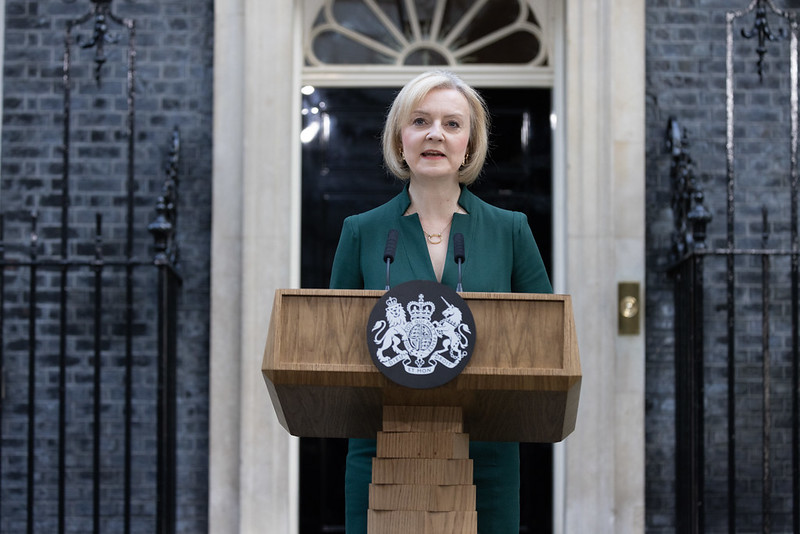
Image: Lauren Hurley/ No 10 Downing Street
Liz Truss famously blamed ‘the markets’ for her failures in government. Here James Marriott and Gavin Bridge take this as a starting point for unpicking the role of markets, and, crucially, their connection to the realm of oil and gas.
Vital signs
13.33 Thursday 20 October. Liz Truss steps out of No 10 and stands before the lectern:
We set out a vision for a low tax, high growth economy – that would take advantage of the freedoms of Brexit.
I recognise though, given the situation, I cannot deliver the mandate on which I was elected by the Conservative Party.
I have therefore spoken to His Majesty The King to notify him that I am resigning as Leader of the Conservative Party.[1]
On the BBC website, as the camera trains on the prime minister, the right-hand side of the screen shows a constantly updating set of figures:
£:$ 1.1277 £:$ 1.1276 £:$ 1.1275
The value of the pound measuring the heartbeat of ‘the markets’. A digital tickertape signalling the health of the body politic.
Truss finishes, turns her back and re-enters the gleaming black door. Chris Mason, BBC Political Editor, speaks live from Downing Street. Behind him the track Mad World plays on a distant sound system, echoing dimly down the canyon of Whitehall.
Another BBC political correspondent (Nick Eardley) explains that Truss’s plan was to make ‘Singapore on Thames’, but it had signally failed. Again and again in the media over the following hours come the lines: ‘The markets turned against us’ … ‘The markets didn’t believe’ … ‘The mini-budget blew up the markets …’.[2] In the days that followed, much is made of the political agency of markets – how Truss and Kwarteng had put forward a libertarian small-state agenda that the markets then rejected.
The markets: what, where and who?
What are these markets that so decisively did for Liz Truss? More often invoked than explained, markets are classic ‘black boxes’ – much is attributed to markets, yet the term itself reveals little. We have also found this in our work on the UK oil sector. Allusions to the ‘oil market’ are ubiquitous. The price of crude oil, for example, is like sterling – an economic vital sign. Fluctuating in real time, Brent crude and the WTI index track the economy’s lifeblood and augur its potential. Yet oil’s markets are elusive. What, where and of whom are they composed?
We can use the evisceration of Trussonomics as an initial guide. Most conspicuously, markets are plural not singular. There are a number of markets for currency, such as the foreign exchange markets (the Forex), where the pound is bought and sold in relation to the dollar, the euro, and so forth – crucially, the dollar, as the figures on the BBC News screen emphasise. But there are also markets for credit and debt (such as bonds), markets for investment (such as equities) and markets for commodities (like oil, gas and copper).
It was the currency market that moved first on Truss, as the pound fell sharply against the dollar to reach a new record low of $1.03. British currency was dumped by investors as confidence in the UK’s economic plan deteriorated.
The bond market was not far behind. Comprising creditors and debtors, the bond market refers to loans – and corresponding debt obligations – made to companies and governments. Particularly punishing for Truss was a sell-off by holders of UK government bonds (so-called gilts). Bond-holders bailed when the government proposed £45 billion in unfunded tax cuts – the largest in 50 years – as credit concerns rapidly matured into fears of fiscal irresponsibility. The ‘yield’ on government bonds soared, making it significantly more expensive to borrow money, leading the Bank of England to intervene to buy up bonds and avoid a collapse in pension funds.[3]
Equity markets also took fright, as inflation and a cost-of-living crisis stoked the prospect of recession. The equity market is made up of investors who own a piece of a company (via shares), and who anticipate that its value will increase over time. As prospects for economic growth diminished, share-owners sought to offload their stakes. The FTSE 100 fell to an 18-month low in October.
The ‘where’ and ‘who’ of these markets is hidden from view. We are used to the way labour, or ‘the workforce’, is characterised in the media through the presence of trade union leaders. We see on our screens the figures of Mick Lynch, Mary Bousted or Arthur Scargill. But almost the only people we know about in relation to markets are fictional traders, characters such as Gordon Gekko or Jordan Belfort. Only occasionally do real-life traders appear, such as George Soros, who famously profited from the ERM Crisis. Or Crispin Odey, whose hedge fund increased its value substantially following the Brexit referendum that he had prominently supported. Now and then the markets appear in the biographies of politicians. Rishi Sunak is often described as a ‘former hedge fund manager’.[4]
The people of oil markets are particularly hidden. They only occasionally break the surface of mainstream media, as happened in 2020, when the tycoon Marc Rich and the ‘Essex Boys’, twelve traders based near Benfleet in Essex, were under investigation in the US for suspected illegal practice.[5] But the normal workings of these markets – the everyday practices that keep capital flowing into fossil fuels, oil and gas circulating to consumers, and profits and rents piling up for shareholders and governments – are opaque and, in most accounts, curiously disembodied.
Towards an anatomy of oil’s markets
Like the markets more generally, oil markets are also plural. It was the commodity markets for oil and, more particularly, gas that set the scene for Truss’s undoing. When prices for oil and gas were driven to record highs by the response of Western governments to Russia’s invasion of Ukraine, the UK government struggled to manage the inflationary consequences for household fuel bills. In choosing to cap energy prices and fund the difference by borrowing through the gilt market, rather than raising taxes, it effectively transmitted shock in the oil and gas markets to the bond market, and created widespread fiscal uncertainty.
That oil and gas could have this proliferating and far-reaching effect reflects, in part, the scale of oil and gas trade. Oil, by a substantial margin, is the single largest traded commodity by value. Buyers and sellers exchange crude oil and petroleum products via spot markets (where trade is for immediate delivery), physical forward markets (where delivery is specified at a future date), and, since the mid-1980s, via futures contracts. Prices reference a handful of ‘benchmark crudes’ against which the price of other crudes are determined. Brent Crude, which refers to a type of crude extracted originally from the North Sea, is the world’s most commonly traded benchmark.
Oil’s commodity markets, however, are closely tied to currency markets. Oil is traded in dollars.[6] This means that countries importing oil need to pay for it in US currency. It also means that oil-exporting countries, like Saudi Arabia and Angola, hold their revenues from oil exports in dollars (these so-called ‘petro-dollars’ are often re-channelled internationally in the form of bank loans or investments). The ubiquity and scale of the oil trade underpins the strength of the dollar as a global currency, and, consequently, the influence of the US over key infrastructures for global trade such as the SWIFT payment system. Efforts to block countries like Russia, Iran and Venezuela from SWIFT have led to some ‘de-dollarisation’ of the oil trade, with sales of oil by these and some other countries ‘now priced in a hodgepodge of Chinese yuan, Russian rubles, importing country currencies and barter’.
Back in the UK, the dollar-denomination of oil and petroleum products creates tensions and stresses along the commodity chain. If the value of the pound drops relative to the dollar, for example, oil refiners in the UK (Essar, Esso, PetroINEOS, Prax and Valero) stand to be squeezed, as they purchase crude in dollars and sell it refined as petrol, diesel or aviation fuel in pounds. The same goes for importers of refined product such as Greenergy. And if they are squeezed, then so too are the companies running the physical trade in oil products, such as Oikos or Thames Oil Port. Same goes for the road tanker and pipeline distribution companies, such as Hoyer or XPO Logistics.[7] And the forecourt retailers such as MFG. And, ultimately, consumers feel the rising price of fuel.
Most of the UK’s oil and gas companies are transnational corporations, with operations in multiple countries. These companies need to engage in the foreign exchange markets to enable their operations across many currencies.[8] BP and Shell, for example, have traders in London’s Forex market who would have been tracking and responding to movements of the pound over the turbulent months of Autumn 2022. Swings in the value of the pound are driven by traders buying into, or selling out of, sterling as it rises or falls. Buyers with substantial capital resources thus aid the momentum of the pound in any direction. Many of the UK’s oil refiners and petroleum product importers listed above, even if using UK subsidiary companies to run assets in Britain, will have faced currency challenges arising from the slide in the pound, as well as upside opportunities arising from the volatility in relative currency values.
Financial oil
Oil’s markets extend beyond oil and gas trading, and the role of oil and gas companies in currency and debt markets: publicly-listed oil and gas companies also occupy a prominent position in the equity market. Shell and BP are among the top six companies on the London Stock Exchange by market capitalisation – with a combined value of around $300 billion – and are thus highly significant in the stability of the UK stock market.[9] The recent dividends and share-buybacks by these companies, in the wake of record profits, have further enhanced their role. Furthermore, BP and Shell – along with other large oil and gas companies – have very substantial pension schemes, with assets invested across a range of companies.[10] Their scale makes them important players in the UK pension market, where, like others, they will have been vulnerable to the instability arising from the sell-off of gilts in the autumn.
The financial markets, however, are where much of oil’s profits are now made. In addition to trading oil futures, oil and gas companies use a range of derivative financial instruments to hedge risks around commodity prices, foreign currency exchange rates and interest rates.[11] BP, for example, rapidly increased its use of financial derivatives in the period between 2017 and 2020, although its involvement in the financial markets has a long history.
The former CEO of BP, John Browne, describes how – when appointed the company’s Group Treasurer in 1984 – he set up an ‘internal bank’ ahead of the deregulatory ‘Big Bang’ of October 1986. As he explains:
the financial markets had yet to be deregulated … but financial techniques were already changing. The team of financial experts who worked for me were full of ideas, which they had never been able to implement … We created BP Finance International as a profit centre and began to make money for BP on very simple things such as centralising foreign exchange transactions.[12]
The company’s trading activities continued to expand. In 1991 Vivienne Cox, who later became head of BP Renewables, created the dedicated commodity derivatives department in the company. As she describes in Crude Britannia:
I brought a few screens, got a few traders … I put all the trading activities together including BP Finance Trading who were buying and selling currencies and debt. It was pulled all together as Integrated Supply & Trading.[13]
Over the last three decades, integrated oil and gas companies like BP and Shell have greatly expanded their oil trading arms. These have in turn become one of their most profitable divisions. In 2016 BP filed its worst annual results in over a century, but these would have been worse still had it not been for the substantial profit of one division, its oil trading arm, Integrated Supply & Trading. This department, with offices at Canary Wharf in London, and in Chicago and Singapore, was bolstering the position of the entire corporation.
Trading thrives on volatility – a volatile market is a market in which profit can be generated. During the Truss government’s weeks of political turmoil, ministers repeatedly asserted that they were acting to ‘calm the markets’ or ‘restore stability’. Businesses, especially in the manufacturing sector, implored them to do so. Others declared that stability was the precondition for the inward investment that would underpin the ‘growth’ that Truss so passionately called for. But stability does not mean profitability in the realm of financial trading. Indeed, the very volatility of the UK’s Forex markets and Gilt markets made the UK more profitable for traders.
Public anger at soaring energy prices and record profits has driven firms like BP to wrap themselves in the national flag, manifested through advertising campaigns like Backing Britain: Delivering Homegrown Energy. The veracity of such claims in relation to BP’s offshore production in the UK North Sea has been widely criticised. If the veracity of the company’s claims to be backing Britain is questionable in the field of oil and gas production, it is non-existent in the field of oil and gas commodity trading or Forex trading. Here, oil company staff operate in a global trading system that functions 24/7 and is supra-national. There is no loyalty to states, despite some of those global traders living in the South East (such as the ‘Essex Boys’). Most of the decision-makers in these markets remain hidden from public view, despite the demonstrable fact that, acting together, they have the power to bring down governments.[14]
£:$1.1277 £:$ 1.1276 £:$ 1.1275
These figures were watched not just by casual viewers of the BBC. Nor only by Tory Party officials concerned about the impact of Truss’s resignation on the pound, and the Party’s prospects in the polls and in any future general election. But also by Forex traders, including oil company traders in Canary Wharf.
Gavin Bridge is Professor of Economic Geography at Durham University.
James Marriott is with Platform, and is co-author of Crude Britannia.
This blog draws on research undertaken as part of Fraying Ties? Networks, Territory and Transformation in the UK Oil Sector (ES/S011080/1). The support of the Economic and Social Research Council (UK) is gratefully acknowledged. Fraying Ties is an interdisciplinary research collaboration, and the authors acknowledge with gratitude the expertise, insight and support of other members of the project team: Alexander Dodge, Nana de Graaff, William Otchere-Darko, Tiago Teixeira, Connor Watt and Gisa Weszkalnys. Thanks too to Terry Macalister, Nick Robins and Annie Brooker. Acknowledging the above implies no responsibility for the arguments or content which are those of the authors alone.
Notes
[1] https://www.gov.uk/government/speeches/prime-minister-liz-trusss-statement-in-downing-street-20-october-2022.
[2] Robert Peston, ITV News 20.10.22.
[3] https://www.cnbc.com/2022/09/29/pension-fund-panic-led-to-bank-of-englands-emergency-intervention.html; https://www.reuters.com/markets/europe/pension-schemes-may-have-needed-employer-support-without-boe-intervention-2022-10-12/.
[4] https://www.theguardian.com/commentisfree/2022/oct/27/rishi-sunak-city-british-politics-investment-banker-prime-minister.
[5] https://www.cityam.com/court-blocks-essex-boys-traders-bid-to-overturn-city-watchdogs-decision/.
[6] By contrast, gas in mainland Europe on the Title Transfer Facility in the Netherlands is traded in Euros per MWh; and gas on the NBP in the UK is traded in pence per therm.
[7] https://platformlondon.org/2021/10/12/petrol-panic-ii-taking-on-the-barriers-to-climate-action/.
[8] BP is clear in its annual accounts that it strives to mitigate against foreign currency risk – see annual accounts of BP International, 30 September 2021
[9] https://companiesmarketcap.com/united-kingdom/largest-companies-in-the-uk-by-market-cap/.
[10] https://pensions.shell.co.uk/scpf/resources/faq.html.
[11] The Hedging Policies of BP with the Systematical Analysis, Nan Huang, Shang Jiang, Yuting Sun and Ziting Yuwen, 3rd International Conference on Economic Management & Cultural Industry, 2021. 125966044.pdf.
[12] John Browne, Beyond Business, Weidenfeld & Nicholson 2010, pp47-49.
[13] James Marriott and Terry Macalister, Crude Britannia, How oil shaped a nation, Pluto 2021, pp398-399.
[14] We may speculate that personnel in the BP trading arm in September 2022 included: Brian Puffer, CFO of BP IST, Carol Howle, Executive Vice President BP Trading & Shipping, and Khalid Alseflan based in the UAE.